
EARTH SCIENCE
EARTH SCIENCE
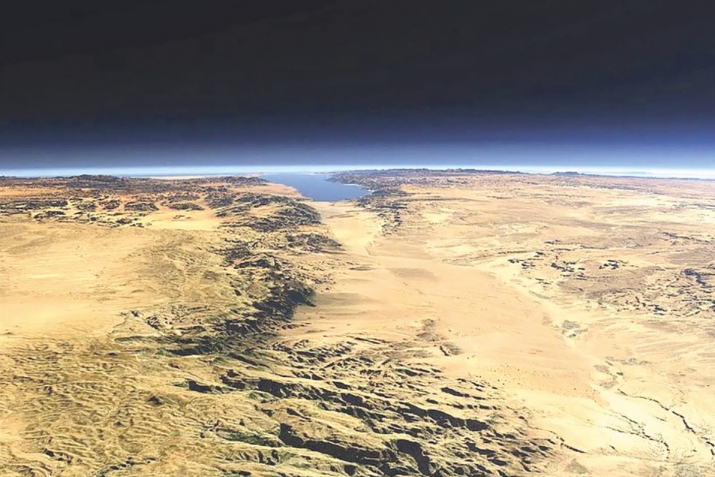
The lowest point on the Earth
In this article we will study God’s saying, “The Romans have been defeated in a land close by,” in order to realize the greatness of our divine book (the Koran) and to understand the amazing miracle in this verse.
The Koran tells us in an era when no man had the knowledge to measure the lowest point on the surface of earth about a battle between the Romans and the Persians which ended with a great victory of the Persians over the Romans. God says (meaning), “Alif-Lam-Mim. [These letters are one of the miracles of the Koran, and none but Allah (Alone) knows their meanings]. The Romans have been defeated ﷻ in a land close by (close by in the original Arabic text is: Adnaa), and they, after their defeat, will be victorious ﷻ within three to nine years. The decision of the matter, before and after (these events) is only with Allah, (before the defeat of the Romans by the Persians, and after the defeat of the Persians by the Romans). And on that day, the believers (i.e. Muslims) will rejoice (at the victory given by Allah to the Romans over the Persians) ﷻ with the help of Allah. He helps whom He wills, and He is the Almighty, the Most Merciful. ﷻ (It is) a promise of Allah (i.e. Allah will give victory to the Romans against the Persians) and Allah fails not in Hisp, but most of men know not. ﷻ They know only the external appearance of the life of the world (i.e. the matters of their livelihood, like irrigating or sowing or reaping, etc.), and they are heedless of the Hereafter.” (Sura Ar-Rum, ayat 1-7).
In this ayah there is a determination of the location of the battle which was (in a land close by), so what does this mean? Can we understand it as the nearest land like the old interpreters or there is another meaning?
The old interpreters had explained (in a land close by) as being the nearest land (of the Romans to the Arabs) which is the area around the Dead Sea.
I concentrated on God’s saying regarding the Al-Aqsa Mosque in the city of Jerusalem. It is only twenty kilometers far from the Dead Sea (the battle field), He be He exalted says (meaning), “Glorified (and Exalted) be He (Allah) Who took His slave (Muhammad) for a journey by night from Al-Masjid-al-Harâm (at Mecca) to Al-Masjid-al-Aqsa (in Jerusalem), the neighborhood whereof We have blessed, in order that We might show him (Muhammad) of Our ayat (proofs, evidence, lessons, signs, etc.). Verily, He is the All-Hearer, the All-Seer.” (Sura Al-Isra’, ayah 1).
Here I started to wonder, how did Allah describe the area of the Dead Sea as being (close by) (close by in the original Arabic text is: Adnaa as the word Adnaa means the nearer) and after that God describes the mosque in Jerusalem with (Al-Aqsa) (Al- Aqsa in the original Arabic text means the farther)?
After that I started to study the geographical maps of the battleground and found that this area is one thousand and two hundred kilometers distant from Mecca. So, how did the Koran described this area as being (close by) which was understood as the nearest place when in reality it is 1,200 km far from Mecca (where Prophet Muhammad and his people were living)?
Hence, I realized that, if Allah means the nearest, why did He use (close by)?
Many meanings for the word
Allah be He exalted created seven heavens and He called the lowest heaven (the lower heaven) (meaning), “So He completed them as seven firmaments in two days, and He assigned to each heaven its duty and command. And we adorned the lower heaven with lights, and (provided it) with a guard. Such is the Decree of (Him) the Exalted in Might, Full of Knowledge.” (Sura Fussilat, ayah 12). In the ayah the word (the lower heaven) has the meaning of near to the Earth but it has another meaning which is the lowest heaven of the seven heavens.
Also Allah says (meaning), “And verily, we will make them taste of the near (near in the original Arabic text is: Adnaa, as the word Adnaa has another meaning which is the fewer) torment (i.e. the torment in the life of this world, i.e. disasters, calamities, etc.) prior to the supreme torment (in the Hereafter), in order that they may (repent and) return (i.e. accept Islam).” (Sura As-Sajdah, ayah 21).
The explainers say that the word (the near) means the torments in this life but God does not mean (the near) as near to us, but He (be He exalted) means the small torment because He (be He exalted and blessed) is comparing two kinds of torments: The near torment (Adnaa) which is the low torment. The supreme torment, which is the big torment.
How can we understand this ayah?
The word (close by) (Adnaa) has three meanings in the Arabic language:
- The nearer: as it is the nearest land of the Roman to the land of the Arabs.
- The smaller: as the area is very small and it does not exceed several kilometers when compared with the area of all earth.
- The lower: this area is the lowest area on earth, as its surface is 422 metres (1,385 ft) below sea level.
This scientific preciseness can be found in Allah’s saying (meaning), “Do they not then consider the Koran carefully? Had it been from other than Allah, they would surely have found therein many a contradiction.” (Sura An-Nisa’, ayah 82).
This ayah tells us that, because this is a divine book and not a human book, we cannot find any contradictions. Where in the human books like sciencific books we may find a proven theory in an era but in another era that theory may be corrected by another. But the Koran is valid for every era and in every place. A main characteristic in the Koran is that the Bedouin can understand it without any problem; also nuclear scientists understand its meanings and as do astronomers. This means that it is a book that is valid for all people in all countries and in all eras.