

Wash your hands
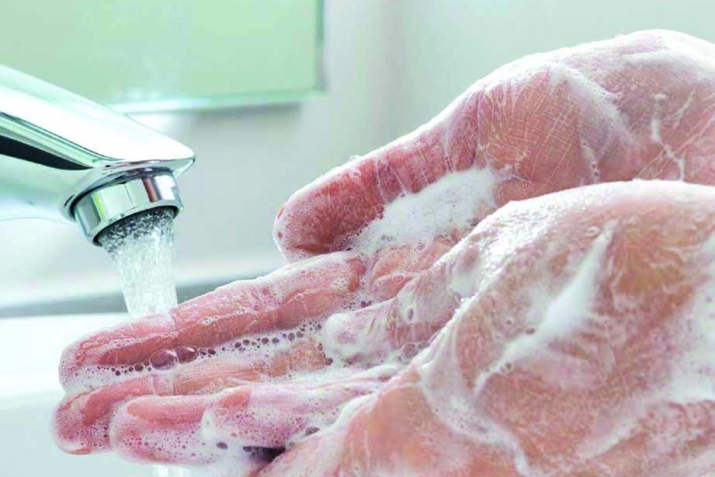
The British medical journal published research confirming that washing hands is much better than any other cure. What does the Quran say? Let us read.
Scientists say that although respiratory viruses usually cause minor illness, epidemics can occur. Mathematical models estimate that about 36,000 deaths and 226,000 admissions to hospital in the United States annually are attributable to influenza, and with incidence rates as high as 50% during major epidemics worldwide, respiratory viruses strain health services, are responsible for excess deaths and result in massive indirect costs owing to absenteeism from work and school.
Concern is now increasing about serious pandemic viral infections. In 2003 an epidemic of the previously unknown severe acute respiratory syndrome (SARS) caused by a coronavirus affected about 8,000 people worldwide, with 780 deaths and caused a social and economic crisis, especially in Asia. A new avian influenza pandemic caused by the H5N1 virus strain threatens greater catastrophe.
Hence, the need for interventions to reduce viral load and mounting evidence suggests, however, that single measures, particularly the use of vaccines or antivirals, will be insufficient to interrupt the spread of influenza. Agent specific drugs are also not available for other viruses. Research published by a British medical journal stated that hand washing is effective in lowering the incidence of pneumonia in the developing world.
Clear evidence has also shown a link between personal (and environmental) hygiene and infection. Researchers say that simple and low cost interventions could be useful in reducing the spread of diseases. Also they confirm that hand washing does not take much time or effort, but offers great rewards in terms of preventing illness as adopting this simple habit can play a major role in protecting our health. Another study shows that Americans are getting lax about cleaning their hands. Researchers said 77 percent of more than 6,000 men and women washed their hands in public restrooms - a 6 percent decline compared with a similar study in 2005.
According to the U.S. Centres for Disease Control and Prevention, hand washing is the single-most important prevention step for reducing disease transmission. In a telephone survey, 92 percent of adults said they wash their hands in public conveniences, according to a study done by the American Society for Microbiology and The Soap and Detergent Association. But the study, which also conducted research at public restrooms, showed people’s actions did not always match their claims.
Men were the biggest offenders, with just 66 percent of men seen washing their hands in public bathrooms, compared with 88 percent of women, according to a study presented at an Inter Science Conference on Antimicrobial Agents and Chemotherapy meeting in Chicago. “Very clearly, guys need to step up to the sink,” said Brian Sansoni, a spokesman for the soap industry group, telling reporters, “One third of guys weren’t washing their hands in public restrooms. That’s gross.” Researchers staked out restrooms at different types of venues in four U.S. cities: Chicago’s Shedd Aquarium and the Museum of Science and Industry, Atlanta’s Turner Field, New York’s Grand Central Station and Penn Station and San Francisco’s Ferry Terminal Farmer’s Market.
The report stated that men’s hygiene was worst at Atlanta’s Turner Field, where just 57 percent of men were observed washing their hands after using the toilet at the baseball venue. But 95 percent of women there washed their hands, the highest percentage observed in the study. Chicago was the city with the cleanest hands overall. New York was the second cleanest; Atlanta came in third, and then San Francisco.
The researchers could not account for why people appear to be washing their hands less in public bathrooms. And they admitted that because the research was done in different venues, it was not scientifically valid. But they said the trend is troubling. “Fifteen to twenty seconds of friction and soap and water will remove so many germs from your hands and help with your wellbeing.
That is a marvellous intervention that will work all over the world,” Judy Daly, director of the Microbiology Laboratories at the Primary Children’s Medical Centre in Salt Lake City, Utah, told reporters. Also, another research published by Cochrane Reviews promoted that hand washing can reduce diarrhoea episodes by about one-third.
This significant reduction is comparable to the effect of providing clean water in low-income areas. However, trials with longer follow up and which test different methods of promoting hand washing are needed.
Islam and hand washing
Many verses in the Holy Koran and many hadith of Prophet Muhammad (peace and blessings be upon him) urge Muslims to wash their hand. This habit is practiced by Muslims five times each day during ablutions. God the Almighty says in this regard, “O you who believe! When you intend to offer As-Salat (the prayer), wash your faces and your hands (forearms) up to the elbows, rub (by passing wet hands over) your heads, and (wash) your feet up to ankles. If you are in a state of Janaba (i.e. had a sexual discharge), purify yourself (bathe your whole body).
But if you are ill or on a journey or any of you comes from answering the call of nature, or you have been in contact with women (i.e. sexual intercourse) and you find no water, then perform Tayammum with clean earth and rub therewith your faces and hands. Allah does not want to place you in difficulty, but He wants to purify you, and to complete His Favour on you that you may be thankful.” (Sura Al-Ma’idah, ayah 6).
Here we see that Muslims are washing their external parts five times a day and the most important thing is that they have to wash even if water is not available by following the “Tayammum” which is to rub dust on face and hands. Today, researchers found that dust can remove bacteria and germs from the body.
Also Prophet Muhammad (peace and blessings be upon him) taught us to wash using water as he said, “If there is a river beside the house of any of you and that man is washing himself five times a day, do you think that he may keep filth in his body? The companions said indeed no, then he replied that is the same as the five prayers - if we persist in them, sins will be removed from us.” (Narrated by Al- Bukhari and Muslim).
BY ABDULDAEM AL-KAHEEL
