
Secrets of nature
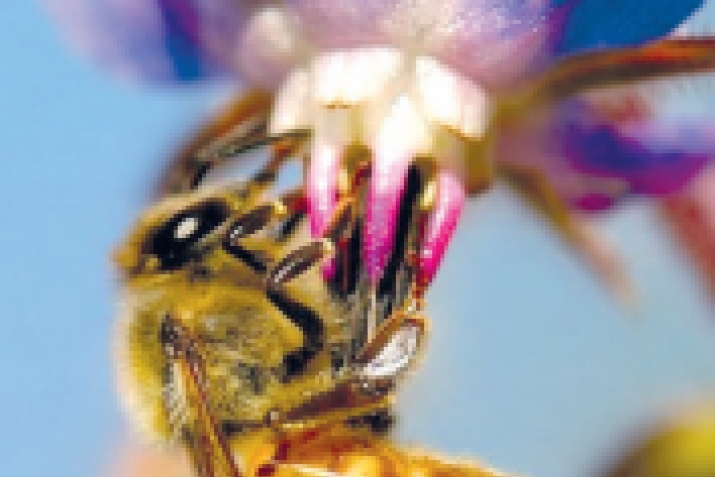
The eye of the bee
Scientists have found that the bee uses ultra violet ray for vision and also that its eyes consist of thousands of small hexagonal lenses whose design provides better vision in forests and help avoid collision with others. A bee can perform one trillion arithmetic operations per second faster than any computer today despite its brain size which is less than the head of a pin! Almighty Allah says, “He is the Originator of the heavens and the earth. How can He have children when He has no wife? He created all things and He is the AllKnower of everything.” (Sura Al Anam, ayah 101)
Researchers have also found that that the brain of a bee is loaded with readymade programs which enable it to perform all the complicated operations necessary to produce honey. Almighty Allah says, “And your Lord inspired the bee, saying, “Take you habitations in the mountains and in the trees and in what they erect.” (Sura An Nahl, ayah 68)
Animals can predict earthquakes
Researchers confirm that the frog is supported by a very sensitive prediction system for sensing earthquakes which is more advanced than any human tool; it can hear the sounds emitted from the ground two days before an earthquake. The frog can detect and measure low frequencies that humans cannot hear so it can move away from an area two days before an earthquake.
In 2004, a destructive tsunami hit the coasts of Indonesia and thousands of people were killed but a little time before the earthquake which cause it dogs ran away and elephants started to call out. Scientists explain that the earth emits vibrations (lower than 20 hertz less than 20 vibrations per second) before an earthquake and tsunami. These animals can detect these vibrations before all advanced machines are able to do so.

Glory to Almighty Allah who created these creatures for our use, as He says: “And has subjected to you all that is in the heavens and all that is in the earth; it is all as a favor and kindness from Him. Verily, in it are signs for a people who think deeply.” (Sura Al Jathiyah, ayah 13)
Animals lie
Many researches confirm that animals can cheat and lie exactly like humans. Researchers in the biology department at the University of Potsdam assure us that lying existed among monkeys, elephants, fish and birds. Glory to Almighty Allah Almighty who told us this scientific reality 1,400 years ago, as He says, “There is not a moving (living) creature on earth nor a bird that flies with its two wings, but are communities like you. We have neglected nothing in the Book and then unto their Lord they (all) shall be gathered.” (Sura Al Anam, ayah 38)
Secrets of camels
The ability of the camel to survive in desert conditions without water for long periods of time is rivaled by none as they can glean much of their needed water from desert vegetation and can survive after losing over 40 percent of their body weight in water. When water is available (fresh or saline), camels drink as much as 57 litres at a time and have a flexible “thermostat” and will not start sweating until their body temperature reaches 42 degrees C. Nor do heating mechanisms kick in during cooler desert nights until the internal temperature reaches 34 degrees C.
Physiological adaptation allows the camel to “store” coolness in preparation for the next day. Almighty Allah says, “Do they not look at the camels, how they are made? And at the sky, how it is raised high? And at the mountains, how they are fixed firm? And at the earth, how it is spread out? Therefore do thou give admonition, for thou art one to admonish.” (Sura Al Ghasyha, ayat 17-21)

Biologists say that a camel’s mouth is very sturdy so as to be able to chew thorny desert plants. Camels also have long eyelashes and ear hairs which, together with sealable nostrils, form a barrier against flying sand. Their gait and their widened feet help them move without sinking into the sand. Also the kidneys and intestine of camels are very efficient at retaining water. Their urine comes out as thick syrup and their feces are so dry that they can be used as fuel for fire.
Camels do not store water in their humps as is commonly believed; their humps are actually reservoirs of fatty tissue. Concentrating body fat in their humps minimises heat trapping insulation throughout the rest of their body and may be an adaptation to living in hot climates. When this tissue is metabolized, it acts as a source of energy, and yields more than 1 g of water for each 1 g of fat converted through reaction with oxygen from air. Glory to Allah who says, “Do they not look at the camels, how they are made?” (Sura Al Ghasyha, ayah 17)
The spider’s house
Scientists say that a spider’s thread is five times stronger than steel! Despite this a spider’s web can be easily destroyed because the spider is not able to produce thick threads its threads are ten times thinner than a human hair. Also the entomologists assure us that the female may eat its children and its mate.

So Almighty Allah tells us that the faith of atheists and disbelievers is like the house of the spider, He says: “The likeness of those who take protectors other than Allah is as the likeness of a spider, who builds (for itself) a house, but verily, the frailest (weakest) of houses is the spider’s house; if they but knew.” (Sura AlAnkabut, ayah 41)
ABDULDAEM AL-KAHEEL