
Index

Iftar

Iftar

Iftar

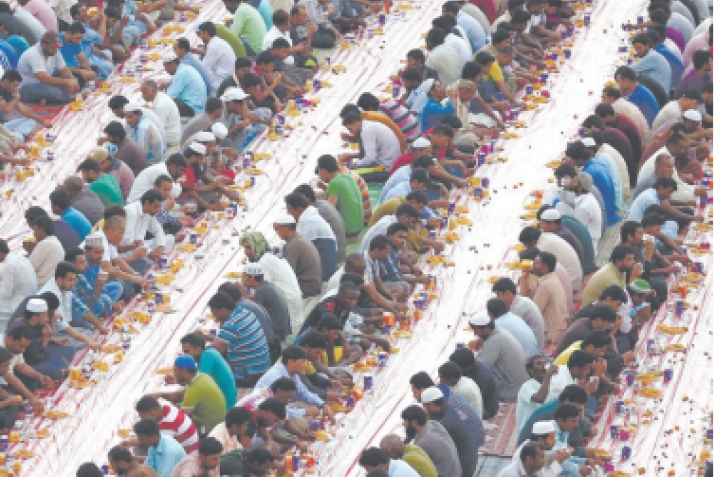
Iftar is observed during the holy month of Ramadan. It is one of the oldest rituals followed by Muslims all over the world. Ramadan occurs in the ninth month of the Islamic lunar calendar during which the whole Islamic community observe a complete fast during the daytime hours.

Muslims take a meal before dawn and only end their fast in the evening with a special meal. This special evening meal is known as Iftar and is taken after the sun sets. The timings of Iftar vary according to when the sun goes down in any given area.

Every Muslim should observe certain principles when he or she is going to break the fast:

Iftar should be immediately taken after the sun sets.

The Iftar breaking of the fast should be commenced with dates, if available. If they are not available, it should start with a sip of milk or water.

In the case of cloudy skies, Iftar should be delayed until the time of sunset is confirmed.

It is considered Makruh (disliked) if Iftar is delayed after sunset or taken before the sunset, as its time is considered to be very auspicious.

Iftar generally starts with Dua (prayer). It is a common belief that Dua made during Iftar are readily accepted. The regular Dua or prayer offered in every Muslim household during Iftar is: “Allahumma Inni laka sumtu wa bika amantu [wa alayka tawakkaltu] wa ‘ala rizqika aftartu” which in English means “O Allah! I fasted for You and I believe in You [and I put my trust in You] and I break my fast with Your sustenance”.

MUHAMMAD YUSUF

2026-08-01 (Safar 1448) №8.


An Illness or a New Way of Perceiving Information

The problem of parent-child relationships has always existed but nowadays it is especially acute, as we find it increasingly difficult to understand each other.   The new generation is growing up in an overwhelming flood of information and this inevitably affects young people. Most videos on...


Salim, Grandson of Umar ibn al-Khattаb

Let us fast forward to the reign of Umar ibn al-Khattab. The richest spoils of war, which had fallen to the Muslims after the death of Yazdegerd, the last Persian king, were brought to Medina – the city of the Messenger of God ﷺ. Among the riches they acquired were the crowns of the Persian...


Al-Dinawari: The Muslim Polymath

Abu Hanifa Ahmad ibn Dawud Dinawari, known as al-Dinawari, was born in 828 in Dinawar (near Kirmashan) and died in 895.   He was a Kurdish scholar of the Islamic Golden Age who made significant contributions to astronomy, botany, geography, agriculture, metallurgy, mathe-matics and history....


Ways to Overcome Suspiciousness

Many of you have probably come across two excerpts from the personal diaries of a husband and wife covering the same short period of time online. The wife’s is a long, emotionally charged text about how her husband once responded sparingly to her greeting and then showed absentminded...


A Modern Disease: Constant Anxiety

In an age when negative news bombards us from all sides, social media dominates, life becomes more complex than ever and the pursuit of luxury and worldly temptations intensifies, anxiety has become a constant companion for many.   This invisible feeling tightens the chest, disrupts peace of...