

Ar-Rabia - The Holder of Opinion
Ar-Rabia - The Holder of Opinion
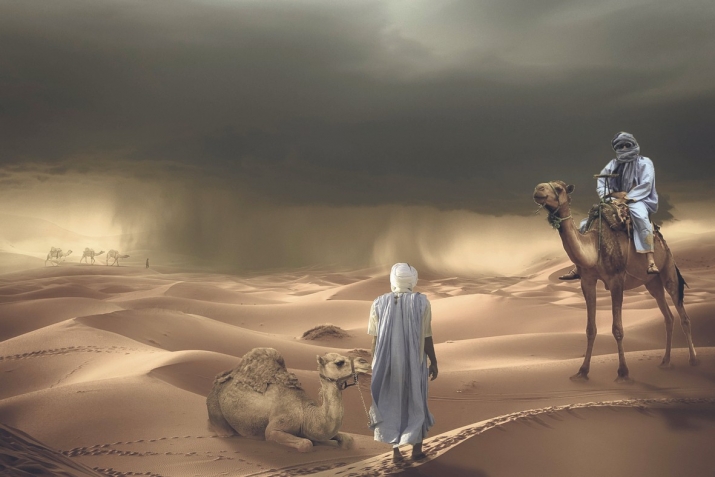
One day, an unexpected change occurred in the quiet life of the scholar Ar-Rabia. One moonlit summer night, an elderly warrior arrived in Medina. He rode through the streets of Medina to his home, not knowing whether his home was still where he had left it, for he had not been in his city for about thirty years. He was overcome with anxiety about what had happened to the young wife he had left in this house and worry about the child she was carrying under her heart.
The streets of the city were still filled with people. They had just performed the night prayer. But none of the passers-by recognized this warrior or paid any attention to him, his noble horse and the sword hanging on his shoulder. This upset the warrior and only increased his fears and suspicions. And when he, immersed in his anxious thoughts, wandered along the streets of Medina that had changed over the years, he suddenly saw his house right in front of him. The door was unlocked. The warrior was so happy that he entered without knocking, without asking permission. The owner of the house heard the creaking of the opening door, looked out from the second floor and saw in the moonlight a stranger with a sword and a spear, who entered his house without permission in the middle of the night. His young wife was very close to the door and the stranger could see her. Enraged, the owner rushed like a lion to the uninvited guest, exclaiming: “Under the cover of night, you break into my house to attack my family?!”
The two men grappled and the neighbors came running to the noise. They surrounded the stranger and grabbed him, wanting to help their neighbor. The warrior said, “I have not committed any sin, and this is my house, which belongs to me,” and seeing that the door was open, I entered.
Then he turned to the people and said: “O people! I am Farrukh.” Is there really no one left among the neighbors who remembers Farrukh, who thirty years ago went to fight in the path of Allah ﷻ?!
The mother of the owner of the house was sleeping but the noise woke her up. She looked out of her room and saw her husband. She was so surprised that she could not utter a word. But, having overcome the shock, she said, “Leave him be. Leave him be, son! This is your father. Go home, o people, may Allah ﷻ bless you.”
As soon as these words reached Farrukh’s ears, he rushed to embrace his son and Rabia began to kiss his hands and head. The people hurried to leave the father and son alone and went home.
Farrukh sat down next to his wife and began to tell her his story and explain why he had been away for so long. But there was something that prevented her from listening attentively to his story and spoiled the joy of their meeting. She was afraid that Farrukh would be very angry when he learned that she had spent almost all the money he had left her. She thought, “What if he asks me about this wealth? After all, he told me to spend wisely, according to custom. What will happen when I tell him that we have nothing left? How will he react if I tell him that I spent what he left me on the upbringing and education of his son? Could the expenses for a child amount to thirty thousand dinars? Will he believe that his son is so generous and noble that he does not keep a dinar or a dirham for himself and that all of Medina knows that he has spent many thousands on his brothers in faith?”
Farrukh looked at his wife, who was lost in her own anxious thoughts, and said to her, “I have brought you, O mother of Rabia, four thousand dinars. Get the money that I left for you. Let us put it together and buy a garden or a plot of land with this money, so that we can live the rest of our lives on the income that it will bring in.”
She did not answer, continuing to think about her own situation. He repeated his request, “Come on, where is the money so that I can add what I have brought to it?”
She said, “I have put it where it belongs, and I will get it in a few days, Allah willing.”
Their conversation was interrupted by the voice of the muezzin from the blessed mosque of the Prophet ﷺ. Farrukh hurried to his jug to perform a small ablution. Then he headed for the door, asking as he went, “Where is Rabia?”
They said to him, “He went ahead of you to the mosque when the first adhan had already sounded. We think that you will not be able to make it in time for the congregational prayer.”
Farrukh, having reached the mosque, found that the people had already finished performing the prayer. He performed the obligatory prayer alone. Then he went to the grave of the Messenger of God ﷺ and greeted him. Then he stopped at ar-Rawza ash-Sharif, between the grave of the Messenger of God ﷺ and his minbar. In this place, so dear to his heart, he had long dreamed of performing the prayer. He chose a place for himself, performed as many rak’at as Allah ﷻ wished, and addressed Him with supplications. He was about to leave the mosque but noticed a large gathering of people who had gathered to acquire knowledge, the likes of which he had never seen before. These people had gathered around their teacher. They sat so tightly that there was no room to step.
Farrukh looked around at the students and saw among them not only young people but also elderly people in turbans and people whose appearance testified to their nobility, influence, and noble origin.
Farrukh tried to see the teacher but he was standing too far away and could not see anything. He was amazed by the teacher’s eloquence, clear, precise explanations, his abundant knowledge and his amazing memory but he was even more amazed by the humility with which the people sat at his meeting. Having finished his lesson, the teacher stood up and the people rushed to him, surrounding him, and he left the mosque, surrounded on all sides by the people who were seeing him off. Then Farrukh turned to the man who was sitting next to him and asked, “Tell me, please, who is this preacher?”
His interlocutor asked in surprise, “Aren’t you one of the people of Medina?”
Farrukh answered, “Yes, I am from Medina.”
His interlocutor said: “Is there really a single person in Medina who does not know our teacher?!”
Farrukh replied, “Forgive me, but I do not know him, because I was absent from Medina for about thirty years and returned only yesterday.”
His interlocutor said, “Well, I understand. Sit next to me and I will tell you a little about him. The preacher you just listened to is the master of the followers of the Companions (tabi'een). He is an expert in the hadiths of the Prophet ﷺ and a great faqih (scholar of Islamic law) and he is the Imam of Medina, despite his youth.
Farrukh said, “As Allah ﷻ willed (Ma sha Allah) and no one has power except from Allah ﷻ (la hawla wa la quwwata illa billah)!”
Meanwhile, his interlocutor continued, “As you saw, Malik ibn Anas, Abu Hanifa an-Nu’man, Yahya ibn Said al-Ansari, Sufyan as-Sawri, Abd-ar-Rahman ibn Amr al-Awzai, al-Layth ibn Sa’d and many others are present at his meetings. He is also a very noble, modest, well-behaved and generous man.
Farrukh said, “But you did not tell me his name.”
He replied, “Oh yes... It is Rabia ar-Rayy.”
Farrukh repeated with surprise, “Rabia ar-Rayy?”
The interlocutor replied: “Well, yes... His name is Rabia. But the people of Medina nicknamed him Rabia ar-Rayy, because when they cannot find an answer to any question in the Book of Allah ﷻ (the Koran) or in the hadiths of the Messenger of God ﷺ, they turn to him and he gives them a decision that the souls readily accept.
Farrukh said excitedly, “But you did not tell me his full name.”
His interlocutor said, “He is Rabia, the son of Farrukh.”
Two large tears fell from Farrukh’s eyes and he hurried home. Rabia’s mother, seeing tears in her husband’s eyes, asked him, “What is the matter with you, O Abu Rabia?”
He replied, “Nothing but good. I have seen in our son knowledge and glory that I have not seen in anyone at his age.”
Taking advantage of the opportunity, she said, “I spent on him everything that you left me. Do you approve of what I have done?”
He replied, “May you be rewarded with good from me, from him and from all Muslims!”
