
Said ibn Jubayr
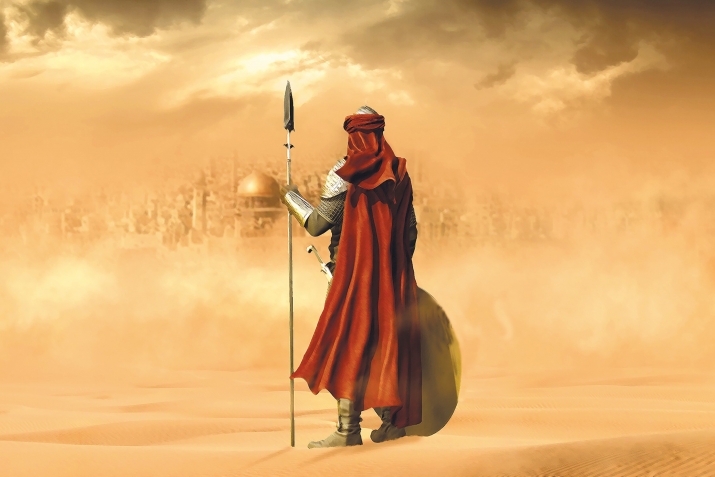
“Said ibn Jubayr was killed when there was no man on earth who did not need his knowledge.” Ahmad ibn Hanbal
He was a strong and energetic young man in the prime of life. In addition, he had a pure heart and a sharp mind. He was dark-skinned, with curly hair - his Ethiopian origin was evident. But this did not diminish the significance of his special, unique personality, which was already evident, in his youth.
The Ethiopian youth, living among the Arabs, understood that knowledge is the right path leading to the pleasure of Allah ﷻ and that piety is the road to Paradise. And he placed piety on the right and knowledge on the left and with persistence and diligence he went through life.
From an early age, people would see him bending over a book and acquiring knowledge or standing in prayer. He was one of the most famous Muslims of his time. Said ibn Jubayr learned from the most prominent companions, including Abu Said al-Khudri, Adi ibn Hatim at-Ta’i, Abu Musa al-Ash’ari, Abu Hurayrah ad-Dawsi, Abdullah ibn Umar and the Mother of the Believers, Aisha (may Allah be pleased with all them). However, his main teacher was Abdullah ibn Abbas the great scholar of the community of Muhammad ﷺ and its boundless ocean of knowledge.
Said ibn Jubayr followed Ibn Abbas just as a person’s shadow follows him. Under his guidance, Said gained a deep understanding of religion and learned to interpret the Koran. He studied Arabic from him and mastered it to perfection. He reached such heights in knowledge that there was no person left on earth from among his contemporaries who did not need such knowledge. He travelled around the regions of the Islamic state in search of knowledge and settled in Kufa, where he became a teacher and imam for the city’s residents.
On one night of Ramadan, he would lead the people in prayer, reciting the verses of the Koran as Abdullah ibn Mas’ud recited, on another night he would recite as Zayd ibn Thabit recited, on a third night he would demonstrate another recitation, and so on. When praying alone, he would sometimes recite the entire Koran in one rak’ah.
Twice a year he would go to the Sacred House of Allah ﷻ (the Kaaba, in Mecca): the first time he went there was in the month of Rajab to perform the Umrah (minor Hajj), and the second time in the month of Dhul-Qa’dah to perform the major Hajj.
Seekers of knowledge, piety and good guidance came to Kufa to tap into the inexhaustible source of knowledge that Said ibn Jubayr was for them. Someone asked him about the fear of the Almighty, and he answered, “Fear of Him is when you fear the Most High Lord so much that it prevents you from disobeying Him.
And when another asked him about the remembrance of the Creator of the worlds, he answered, “Remembrance is submission to the Almighty Allah. Whoever turns to Allah ﷻ and submits to Him, remembers Him. And whoever turns away from Him and disobeys Him is not a rememberer, even if he glorifies Allah ﷻ all night and reads the verses of the Koran!”
At the time Said ibn Jubayr settled in Kufa, it was ruled by al-Hajjaj ibn Yusuf al-Thaqafi, who was the governor of the two Iraqs (Kufa and Basra), the eastern regions and Mawarannahr. This was at the height of his power and tyranny and was after he killed Abdullah ibn az-Zubayr, extinguished the flames of rebellion that broke out here and there and cut off many heads. The hearts of the people were filled with fear of him and his tyranny.
Then Allah ﷻ willed that discord would begin between al-Hajjaj ibn Yusuf and one of his greatest military leaders, Abd ar-Rahman ibn al-Ash’as. This conflict caused a turmoil that destroyed everything in its path. At first, Abd ar-Rahman ibn al-Ash’as and his troops were victorious but gradually al-Hajjaj began to achieve victories and eventually inflicted a crushing defeat on Abd ar-Rahman. Abd ar-Rahman fled for his life and his army surrendered to al-Hajjaj and his warriors. Al-Hajjaj ordered an announcement to be made to those who had surrendered that he was calling on them to renew their oath of allegiance to him. Most agreed to renew their oath, while some went into hiding. Among those who went into hiding was Said ibn Jubayr.
When those who had surrendered began to take the oath, they encountered something they could not have expected. Al-Hajjaj asked them one by one, “Do you testify that you have become an unbeliever when you broke your oath to the viceroy of the Commander of the Faithful?” If the man answered in the affirmative, al-Hajjaj accepted his oath and released him. But if he answered in the negative, he was executed. Some submitted to al-Hajjaj and declared themselves unbelievers in order to save themselves from certain death. But others showed steadfastness and perseverance and paid for it with their heads.
An old man from the Hasam tribe remained apart from both groups and lived beyond the Euphrates River. He was brought to al-Hajjaj along with the others.
When he was brought before al-Hajjaj, he asked about his situation and the old man replie,: “Since this flame flared up, I have not joined anyone and have lived beyond this river, awaiting the outcome of the battles. And when you won, I came to you to swear allegiance.”
Al-Hajjaj exclaimed, “To hell with you! You were just sitting there waiting instead of fighting with your master?! Do you testify that you are an unbeliever?”
The old man replied, “I would be a bad man if I admitted to being an unbeliever after eighty years of worshiping Allah ﷻ!”
Al-Hajjaj became angry, “Then I will execute you!”
The old man said, “Even if you kill me, I have only as much life left as a donkey can live without water. And he, having drunk in the morning, dies in the evening. Indeed, I expect to die both morning and evening. So do what you want.”
Al-Hajjaj ordered his executioner, “Cut off his head.”
The executioner cut off the old man’s head. And there was not a single person present, whether they were al-Hajjaj’s close associates or his enemies, who did not feel respect for this old man, did not pity him and did not call upon him the mercy of Allah ﷻ.
Al-Hajjaj summoned Kamil ibn Ziyad an-Nakha’i and asked him, “Do you testify that you are an unbeliever?”
He replied, “By Allah ﷻ, I do not testify!”
Al-Hajjaj announced his decision, “I will execute you!”
Kamil replied, “Allah ﷻ will judge between us when we meet with Him. And after the murder there will be a reckoning.”
Al-Hajjaj became angry, “On that day the argument will be against you and not in your favor!”
Kamil objected, “This would be so if you were the judge that day.”
Al-Hajjaj said, “Kill him!”
Kamil ibn Ziyad an-Nakha’i was executed.
Then another man was brought to al-Hajjaj, whom he had long dreamed of killing, because he had been told that he mocked him. He said to him, “Indeed, I see before me a man who, I think, will not testify that he is an unbeliever!”
The man replied, “Do not try to confuse and deceive me. I am the most unbeliever of all the inhabitants of the earth, even more unbelieving than the Egyptian pharaoh.”
And al-Hajjaj let him go, although he was eager to kill him.
To be continued…