
THE HISTORY OF HAJJ IN RUSSIA
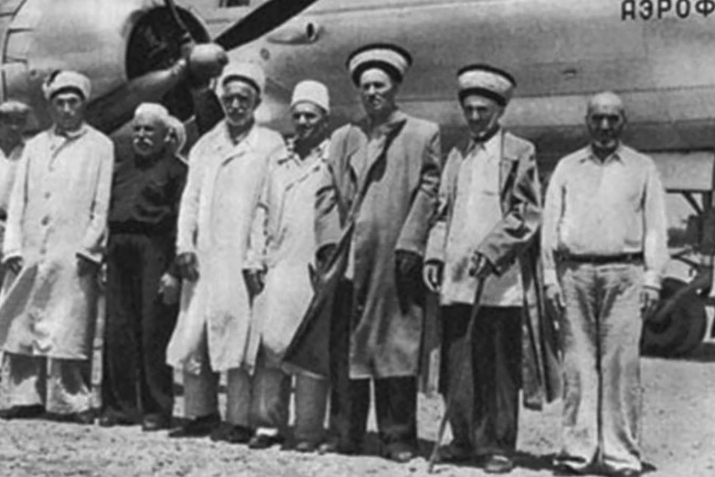
The implementation of the fifth pillar of Islam - the pilgrimage to the shrines of Mecca and Medina - Hajj - in Soviet times was almost impossible. Impossible, but still real for those who had Iman (faith), the desire to accomplish fard - and at the same time possessed the skill and ability to break through ideological barriers and prohibitions.
Historical reference
The first decree on the hajj, allowing Bukharans residing in the territory of Russia to receive passports and perform Hajj to Mecca, was signed by Emperor Alexander the First on March 23, 1803.
Since the 70s of the XIX century, the Hajj problems of Muslims - subjects of Russia - had become actively discussed in foreign affairs agencies: the Ministry of Foreign Affairs, the Embassy in Constantinople and in the consulate in Jeddah opened in 1891. Moreover, the heads of administrations of those regions where the Muslims lived compactly were also involved: the Novorossiisk, Turkestan, Bessarabian governors-general and the Caucasian governor. The reason for this was mainly the Caucasian War of 1818-1864 and the accession of the greater part of Turkestan, territories with a Muslim population, which differed sharply not only from the Centre, but also from those regions of internal Russia where Muslims lived compactly (the Volga region). At the top the authorities demanded from local officials that they report the situation connected with the pilgrimage of Muslims and make decisions based on this information.
The Russian authorities issued passports to Muslims with extreme reluctance, because they believed that "the Hajj brings huge material benefits to Turkey by donations... which is used for military needs," and also believed that "during the hajj, various epidemic diseases appear and develop - mainly cholera and the plague."
Statistics, which led the Russian administration, also caused concern. Thus, it was established that in 1898 some 1,793 Russian citizens visited Mecca. However, pilgrims also went to Mecca without passports.
At the turn of the XIX-XX centuries the Hajj was performed by about 5,000 to 10,000 Russian Muslims who traveled to Mecca (http://haj.ucoz.ru).
What happened then
Very different people then came to power in our country, and there was no talk about thousands of "Hajj" performers anymore. As noted above, it was forbidden to do everything to do with faith: pray, fast, visit mosques, that, moreover, were destroyed, turned into stables - or into cultural centres... In short, they destroyed religion as best they could. And this concerned not only Islam but also other faiths. However, those who engaged in such unseemly acts, certainly did not know that you can destroy, damage and trample on the external manifestations of faith but the internal content is never destroyed. Faith as it was in the souls of Muslims still remained.
Many ethnic Muslims were so Russified that it is still difficult for them to find their roots. However, this does not mean that they do not realise their nationality and at the same time they also have confessional identity.
The Hajj itself is quite difficult to accomplish due to material costs, physical, psychological and moral challenges. When there is a ban "from above", additional complications are imposed. For those who still managed to do this, the hajj became a heroic deed. During the Soviet years, no more than 20 people traveled to Saudi Arabia to perform the Hajj. Many historians say that this period concerning the pilgrimage has been little studied, because many archival materials are still classified and therefore inaccessible to the general mass for decoding, reading, and analysis. Little is revealed. It would seem that much is known to us about those not-the-best-times for religion, but here is the fifth pillar of Islam - the Hajj - which now still remains a mystery.
Statistics
In 1903 Russia sent 5,000 pilgrims on the Hajj, in 1904 - about 7,000, and in 1905 – 10,000. In 1905 Russia entered the war with Japan and took a great stride into the first Russian revolution and civil war - the “European model of self-destruction for Russia”. That meant the sacrifice of its traditional Orthodox and Muslim spirituality and unity of nations - the foundations of its majesty - to the “dictatorship of the proletariat”. For the information of the reader, Japan contributed $10 million for the needs of the First Russian Revolution in 1905 - 1907.
The unique historical phenomena of the 20th century - revolutions and wars - proved to be 1) profitable businesses, 2) powerful tools of domestic and foreign policies, 3) a disguised form of mass embezzlement of public funds, 4) a factor justifying corruption and organized crime activities, 5) ideological justifications of authorities’ illegal actions towards their own citizens in cases of emergency, 6) shadow schemes of mass outflow of raw materials, minerals, technologies, capital, intellectual resources and promising staff, etc.
In the early 20th century, the infused from abroad ideas infused from abroad about “the sovereignty of people, revolutionary reforms and democracy” that were imposed on Russia based on the Euro-Atlantic model of social development, hurled back the once mighty power to the abyss of the world with devastating civil wars and endless revolutionary reforms, repressions, thaws, stagnations and perestroikas.
The issues of the Hajj were pushed to the sidelines. The pilgrimage, and religion in general, were considered now old prejudices. After the repressions at the end of the 1930s, the relations with the Kingdom of Saudi Arabia were “curtailed” and the embassy was closed. During World War II in 1941–1945, the attitude towards organizing pilgrimages of Muslims somewhat changed. From 1945 to 1990, the Soviet Union could receive and use a quota of up to 25 people a year for a population of 250 million people, of which Muslims constituted from 40 to 60 million according to various estimates. In these circumstances, the Russian Federation (as a subject of the Soviet Union) had no quota of its own and had to ask occasionally from the Religious Boards of Muslims of the Central Asian republics for 4-5 places to be given to the Muslims of Russia.
Needless to say, the Muslims of Russia rightly drew the attention of the Russian authorities to the clear injustice in dealing with the issues of religious rights and freedoms guaranteed by the Constitution of the USSR. Until 1985, the allocation of 3-5 places for Dagestani Muslims even though not on a regular basis, was a marquee event, on the one hand, while on the other hand, it was accompanied by scandals that pilgrims were going to the Hajj from the wrong regions.
Everyone used to think that he alone and his region were the only worthy of the right to go for pilgrimage. To be honest, it was a difficult period for the government and religious organizations.
Year 1985. Perestroika burst upon the scene and opened for its citizens the borders for exit and entry into Russia. As a result of the democratization of the public life, constitutional recognition and legislative consolidation of religious rights and freedoms, Muslims now had the right to perform annual pilgrimage.
Respect has been returning gradually for the traditions of Russian Muslims, for the historical experience of interaction and cooperation of authorities at all levels with religious organizations. Favorable domestic and foreign circumstances are provided annually in modern Russia for organizing the Hajj pilgrimage. For this purpose, the potential of state, administrative, inventory, financial, international and human resources, nongovernmental, public and religious organizations is mobilised.
Source: Islam.ru.en