
The arabic teacher
It was back in 1989. At that time, everyone lived as if in a waiting room of some railway station. We could feel that something was bound to happen but didn’t know whether it was going to be something good or bad. The price of the ice cream in the nearby cinema kiosk almost doubled, and the pocket money was now sorely lacking. Every morning my father would give me five kopecks for a Danish pastry and another three kopecks for a compote if I got an A in school the day before. I would sporadically save this money for all sorts of girlish joys: crayons, scrunchies, matches, and ice cream. But then the ice cream suddenly became a rare delicacy...
Our school principal canceled the school assemblies of pioneers in the mornings and introduced morning exercises instead. Waste paper collection was also abandoned, even though it was the most interesting thing to do: we would go door-to-door and collect old newspapers and, if we were lucky, books and old magazines; later, we would sit in our balcony and cut out beautiful pictures from them and make collages.
That year, we had a newcomer in our class. I don’t remember his name or where he had studied before he was transferred to our school. He was practically no different from other boys in the class, except that he used to carry his books not in a backpack, like everyone else, but in a sports bag, over his shoulder. In all other things, he was neither better, nor worse than anyone else. Like others, he would get his math tests done by the local child prodigy, Alik, and run to the next building to tease high school students. He would often show up without his pioneer neckerchief – not in an act of protest, but because he was too lazy to wash and iron it.
Once, during the class of natural history, our classroom teacher Mrs. Stalina Matveyevna summoned him to front of the class in order to demonstrate why shoulder bags were bad for the posture. After that we mocked and teased him.
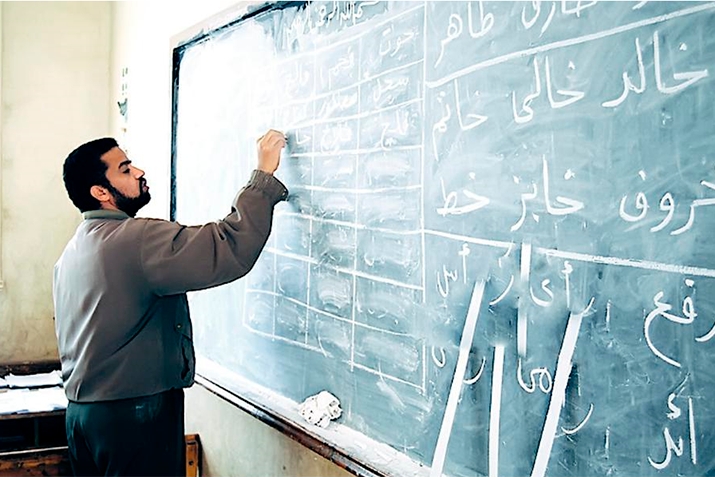
Another day, he had a fight with a boy, and everyone learned that the newcomer knew karate. The mother of the beaten boy cried foul and demanded that the offender be expelled from school, but the situation was ambiguous, and both boys were equally at fault. So it all ended with a classroom lecture and a reprimand. After this incident, the boy’s father came to school and offered to give Arabic lessons. Mrs. Stalina Matveyevna agreed, the parents were informed. Nobody seemed to have any objections, although we had Russians and Jews in our class.
Every Wednesday, we stayed after school and waited for our teacher. During the first class, he told us a phrase in Arabic that he immediately translated – it was simple but very beautiful. We liked everything: that the notebook begins from the end, that we had to write from right to left, and that the teacher gives “non-Russian” grades. No one skipped the class except his son, as he already knew what we only were beginning to discover. Once, as the Arabic teacher was checking my work – we had just learned a new word “brother” – he said that my handwriting was beautiful. No one had ever called my handwriting beautiful.
These lessons were devoid of any religious overtones – we were simply taught to read and write in a new language. But we were taught by a real teacher – someone who could not only interest the children in the subject but also teach them something new. And yet, he was never paid for it. More than twenty years have passed, but I remember every lesson and even the alphabet, exactly to the letter where we stopped, and the two words that we had learned.
One day, the Arabic lessons suddenly stopped. The teacher simply did not come to class, nor did his son come to school. We were 9 or 10 years old, and we didn’t understand much then, but even the adults knew no more than us. There were different rumors, and it was impossible to learn what had truly happened. I still do not know what was true and what was imagined by my classmates and teachers, but I do remember my Arabic lessons.
GURIZADA KAMALOVA